Sunday, 2 April 2023

Industrial Context

  Timeline of Music Videos:

  • 1926- The 'Talkies' were introduced, this involved musical short films featuring bands, vocalists and dancers
  • 1930- 'Screen songs' were introduced. This included a series of cartoon films which encouraged audiences to sing along by following a marker
  • 1964- The Beatles became one of the most famous bands in the world with their modern music video for 'A Hard Days Night'
  • 1981- The music channel MTV was created. This enabled music videos to play a central part in music marketing by the mid 1980's 
  • 1984- Michael Jackson released his music video 'Thriller’, which proved to be a big hit
  • 1985- The music channel VH1 was launched. This featured a range of soft music to suit an older audience helping to broaden the audience of music videos
  • 1988- Hip Hop began to increase in popularity 
  • 1992- Director names were shown in the credits of music videos
  • 1995- Michael Jackson’s music video ‘Scream’ becomes one of the most expensive music videos, costing a total of 7million dollars to create
  • 2005- ‘iTunes’ opens allowing people to download their favourite tracks from the computer
  • 2005- The online entertainment website ‘YouTube” was created enabling music lovers to access their favourite music videos online. This resulted in an increase of new artists
  • 2010- The number of music videos viewed online begins to massively increase
  • 2010- Lady Gaga’s music video ‘Poker Face’ reaches one billion views

Contemporary context:
The music industry is concentrated and dominated by three main players. The three largest record labels are Universal Music Group (32% market share), Sony Music Entertainment (20%), and Warner Music Group (16%) - hold a 68% share of the music recording market.

How companies finance their products?
Typically, labels front the money for music video production. Since record labels are the beneficiaries of the royalties that come from those videos, it's usually their obligation to pay for them. Artists who are not signed need to be self-financed. Most streaming revenue comes from user subscription fees for services such as Spotify, Apple Music and Amazon Music Unlimited. In simple terms, the DSPs divvy their pools of subscription revenue according to the number of times a track was streamed in a particular month.

How do companies distribute their products?
A lot of music videos are distributed through distribution services, including Ditto, PeakSound, RouteNote and CDBaby which are some of the most popular streaming services. People also use platforms such as YouTube in order to maximise their audience and increase their viewings. From this many, there is a wide range of well-known apps that will be useful in order to help promote the song, for example: Spotify, Apple Music, Vevo and Tidal. These all require the artists to use music video distributors to deliver their content and have it viewable on these platforms. Artists will also get the benefit of accessing a verified artist account for each of these platforms.

How do companies exchange their products?
Streaming royalties and digital downloads are two of the most common ways music videos make money. Whenever a song is streamed on services like Spotify or Apple Music, the artist will earn a royalty. The amount an artist earns from streaming royalties varies depending on how popular their song is.

How do audiences access music videos?
Most music videos are consumed through platforms such as YouTube. YouTube is the largest and most popular resource for online music videos. There's a huge number of official music videos that you can watch for free, as well as a plethora of user-made videos that cover every conceivable topic.

Beggars Group:
Beggars Group are one of the largest independent groups of labels in the world. The label was born in 1977 with the 7th release of 'Free Admission Single' by The Lurkers. Success was quick to follow via one of the first signings, Gary Numan. The label was founded by Martin Mills and Paul Redding is the CEO of Beggars Group. The Beggars Group now comprises many of the world's most respected independent labels and currently has 5 primary active labels including 4AD, Matador Records, Rough Trade, XL Recordings and Young. They self-distribute digitally and to US indie stores. They have numerous Brit, GRAMMY® and Mercury Music Prize wins among them, including Adele, Radiohead, The Lurkers, Dizzie Rascal and The Prodigy. 
 
Codes and Conventions:

Thursday, 30 March 2023

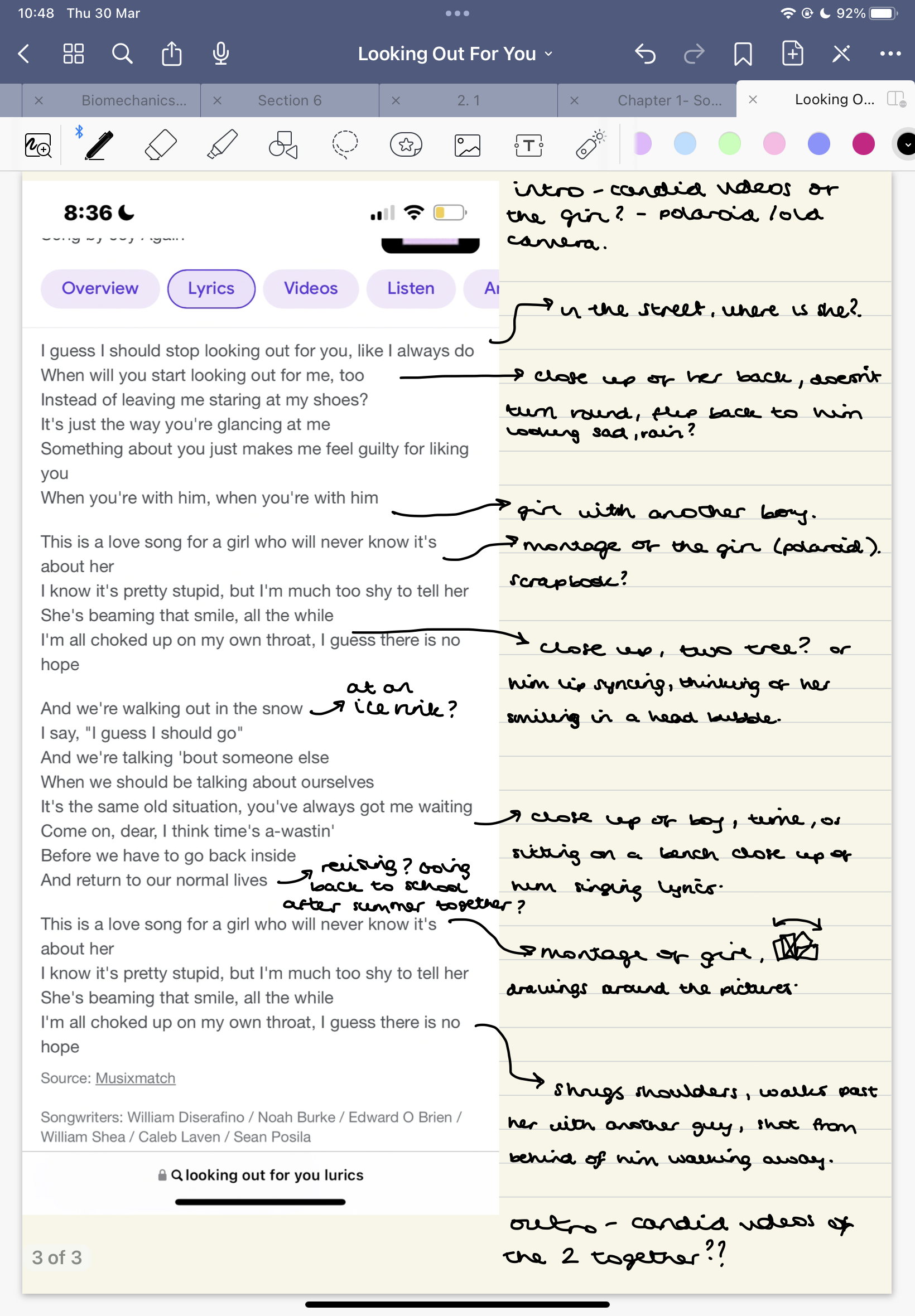
Annotated lyrics


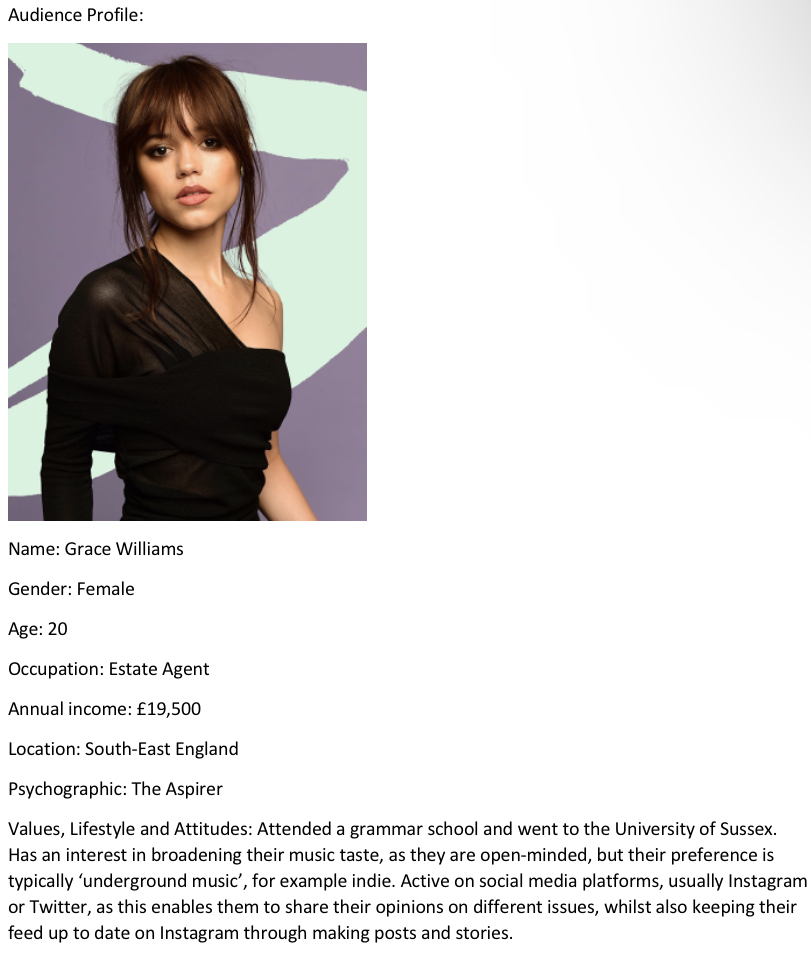
Audience Research

 The brief’s audience is aimed at 16-25 year olds. This is quite a broad range as at 16-18 most people are teenagers that are still in education, compared to 20+ year olds whose life plan could be very varied and broad. For example, they could potentially have a stable and sustained career path, they could have children or they could still be at university depending on their interests. This makes it somewhat trickier to emotionally engage the audience of all ages. All of the people included in this age range would be very reliant on technology as they are classed as Gen Z, this means that they would be up to date with technological advancements and would be constantly kept up to date with recent news stories and what’s going on on the world. The brief for a music video relates well to the audience age range, as especially for the teenagers it can relate to their summer holidays as it sets the same sort of tone. Also, for the older audience it gives them a chance to reflect on their experiences so they will experience some nostalgia whilst watching the music video. They will spend a lot of time on social media as it is very prominent in modern society, this means that they will be very open and engaged in different social media platforms, including YouTube which will feature a range of different music videos from any genre. TikTok is also an upcoming phenomenon that all age ranges use in their everyday lives.


What does this demographic engage with in terms of popular culture?

They are very active on social media, as they want status brand that show their place in society, as they are typically aspires. They use apps like Instagram as this gives them a way to show their status through luxury goods that would be prominent throughout their feed, as they are also considered stylish and so they would want present themselves with this persona. They would also be active on TikTok as they like to keep up to date with new trends, and TikTok is a common platform to do so on. Due to the fact that they are not a passive audience, they will be exposed to lots of celebrity endorsement throughout, for example through adverts that constantly come up which will relate to the persons interests, which may persuade the person to buy a certain item to be like that celebrity.


What does this demographic engage with in terms of my chosen brief?


Wednesday, 8 March 2023

Research into Beggars Group and Bauer Media

   Beggars Group:


Beggars Group are one of the largest independent groups of labels in the world. The label was born in 1977 with the 7th release of 'Free Admission Single' by The Lurkers. Success was quick to follow via one of the first signings, Gary Numan. The label was founded by Martin Mills and Paul Redding is the CEO of Beggars Group. The Beggars Group now comprises many of the world's most respected independent labels and currently has 5 primary active labels including 4AD, Matador Records, Rough Trade, XL Recordings and Young. They self-distribute digitally and to US indie stores. They have numerous Brit, GRAMMY® and Mercury Music Prize wins among them, including Adele, Radiohead, The Lurkers, Dizzie Rascal and The Prodigy. 


Bauer Media Group:
Bauer Media Group is one of the world's largest privately-owned media business with media assets all over the globe. It was founded in Hamburg in 1875 and it is now in its 5th generation of family ownership. The Bauer Media Group reaches 200 million consumers worldwide and operates in 14 countries, including the UK. Within the company there is 15,000 employees. Bauer strives to creating a culture at work in which diversity is appreciated and supported. they also use audience iSight to get a deep understanding of their audiences, as they believe it is crucial to understand how behaviours, values and attitudes are changing.

NEA music video

   Music Video:


For the NEA I am between the music video and magazine. I was originally set on doing a magazine as I thought I could potentially struggle with the creative side to a music video, as in what narrative I should include. Also, I think that with my knowledge and skills gained from GCSE media when I chose to do a DVD cover, that it would also help with the use of photoshop in creating my final product. I am very passionate about films so this could also help me if I did choose to pick this brief, however, I think I would struggle with the brief for the magazine as I would have to come up with my own film and base it off that. I have still not finalised my decision yet, but as of currently I think I am more drawn towards the music video. I am drawn to it because I feel like there is a good brief for it and I think it could be taken in a number of different directions. I also like that it is based off of indie music, as I think with summer coming up the two would work well together. Recently I have been looking for some inspiration and potential songs that could be used for my final product and I have enjoyed doing so, it has helped me with starting to plan ideas of what the narrative could be, however much more thought would be needed to help me perfect a narrative as it is something I believe I would struggle with creating. I would set the music video in summer and I will find a song that reflects a similar tone, so it would have a faster, upbeat feel to it, as I think this relates to the time of year and having fun. I want to include a range of different shot types in the music video in order to portray the narrative taking place, e.g. ranging from wide shots to extreme close ups.

Final Statement of Intent